Search is no longer just about ranking blue links.
In the generative AI era, search engines are evolving into answer engines, delivering direct, contextual responses instead of traditional result pages. This shift is redefining how users discover information — and how websites must optimize to stay visible.
Welcome to the future of search, where AEO (Answer Engine Optimization) and UX-driven SEO are no longer optional, but essential.
This article explores how search is changing, why traditional SEO alone is no longer enough, and how to master AEO and user-centric optimization to win visibility in AI-powered search experiences.
1. How Generative AI Is Reshaping Search
AI-powered search systems analyze intent, context, and semantic meaning rather than just keywords. Instead of showing ten blue links, they aim to generate the best possible answer instantly.
This means:
-
Fewer clicks, but higher expectations
-
Strong preference for clear, structured, trustworthy content
-
Heavy reliance on contextual relevance and UX signals
Search engines now ask:
“Which page gives the clearest, most helpful answer — with the least friction?”
If your content cannot be easily understood, summarized, or trusted by AI systems, it will simply be ignored.
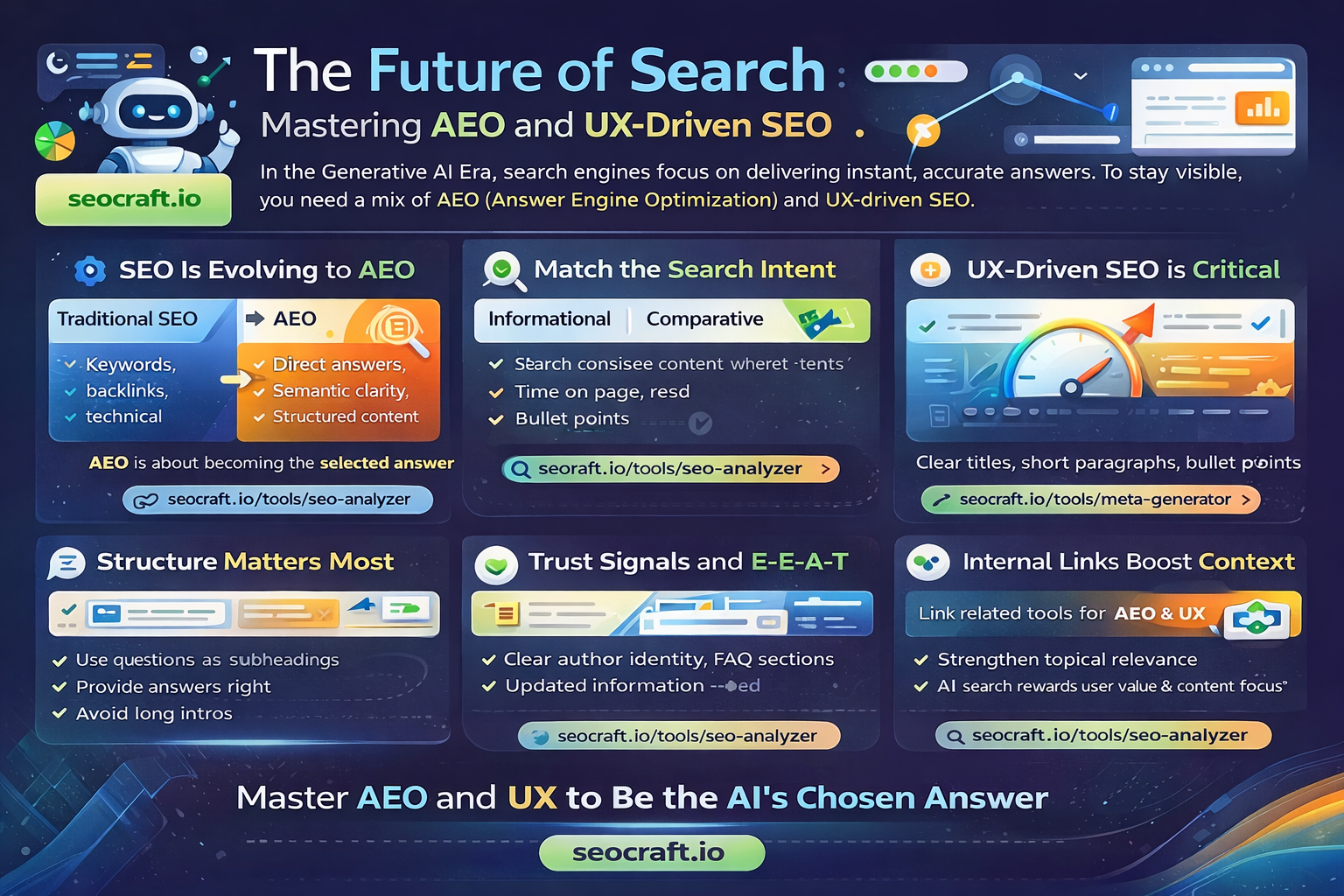
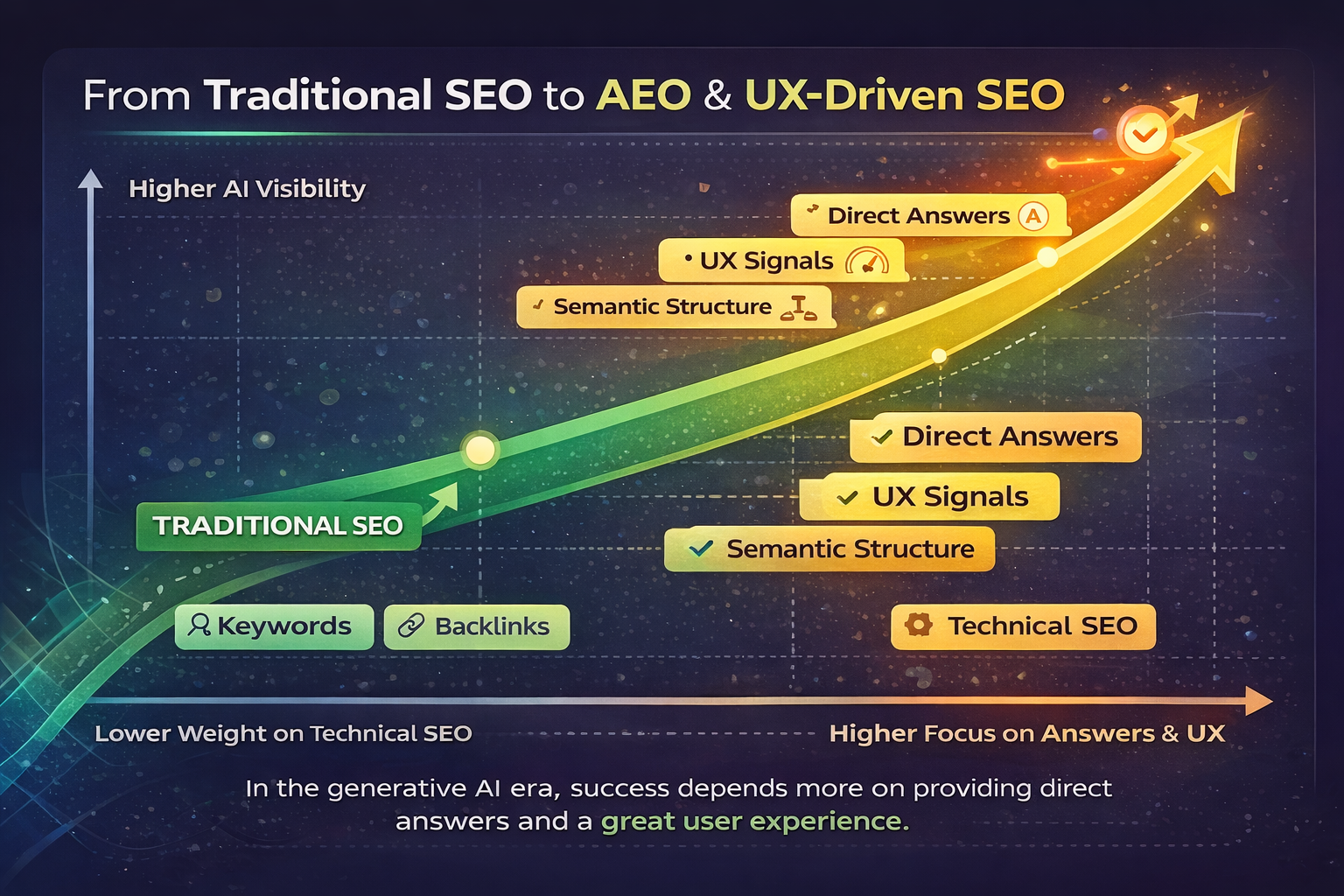
2. From SEO to AEO: What’s the Difference?
Traditional SEO focuses on:
-
Keywords
-
Backlinks
-
Technical optimization
AEO (Answer Engine Optimization) focuses on:
-
Direct answers
-
Semantic clarity
-
Structured information
-
Question-based content
In short:
SEO helps you rank.
AEO helps you get selected as the answer.
To support this shift, your pages must clearly define:
-
What the page answers
-
Who it’s for
-
Why it’s trustworthy
This is where tools like structured data generators become essential.
👉 Using the Schema Markup Generator from SEOCRAFT
https://www.seocraft.io/tools/schema-markup-generator/
helps search engines understand your content at a machine level, increasing the chance of being featured in AI-generated answers.
3. Search Intent Is the New Ranking Signal
In the generative era, search intent outweighs keyword density.
Modern intent types include:
-
Informational (What is AEO?)
-
Comparative (AEO vs traditional SEO)
-
Action-driven (How to optimize content for AI search?)
Your content must fully satisfy the intent, not partially.
Before publishing any article, analyze:
-
Is the intent educational or transactional?
-
Does the user want a quick answer or deep guidance?
-
Can the answer be summarized easily?
You can audit intent alignment using SEOCRAFT’s On-Page SEO Analyzer:
https://www.seocraft.io/tools/seo-analyzer/
It helps identify:
-
Missing headings
-
Poor content structure
-
Over-optimization issues
4. UX-Driven SEO: Why User Experience Now Directly Affects Rankings
In AI-powered search, UX is SEO.
Search engines increasingly evaluate:
-
Time on page
-
Scroll depth
-
Content readability
-
Mobile usability
-
Page clarity
If users struggle to read, navigate, or understand your content, AI systems interpret this as low answer quality.
Key UX principles for the generative era:
-
Clear H1 and logical H2/H3 hierarchy
-
Short paragraphs (2–4 lines max)
-
Bullet points for scannability
-
Fast loading pages
-
No visual clutter
Poor UX = poor AI summarization.
5. Content Structure Matters More Than Length
Long content still matters — but structure matters more.
AI systems prefer content that is:
-
Modular
-
Well-segmented
-
Easy to extract answers from
Best practices:
-
Use questions as subheadings
-
Provide direct answers immediately after headings
-
Avoid unnecessary storytelling before the answer
To validate structure and metadata quality, tools like the Meta Tag Generator are crucial:
https://www.seocraft.io/tools/meta-tag-generator/
Optimized titles and descriptions help AI systems understand:
-
Topic relevance
-
Page purpose
-
Audience focus
6. Trust, E-E-A-T, and AI Credibility Signals
Generative search systems prioritize trust more than ever.
Key credibility signals include:
-
Clear author identity
-
Transparent purpose
-
Consistent topical authority
-
Accurate, updated information
Pages without trust signals are less likely to be used as AI sources.
Improve trust by:
-
Adding FAQ sections
-
Including structured schema
-
Avoiding exaggerated claims
-
Using neutral, informative language
Remember: AI does not reward hype — it rewards clarity and reliability.
7. AEO Content Formatting That Works in 2026
To increase your chances of appearing in AI-generated answers, format content as follows:
-
Direct answers first
-
Definitions in one clear sentence
-
Lists instead of long explanations
-
Tables where comparisons are needed
-
FAQ blocks for common follow-ups
Avoid:
-
Keyword stuffing
-
Overly long intros
-
Hidden answers
-
Clickbait headings
Use tools like SEOCRAFT’s SEO Analyzer to spot content that is difficult for machines to interpret.
8. Internal Linking for Context, Not Just SEO
In the generative era, internal links help AI systems understand topical relationships.
Link related concepts naturally:
-
From SEO articles → schema tools
-
From UX content → analysis tools
-
From guides → calculators and generators
Example:
If you discuss structured data, link directly to:
https://www.seocraft.io/tools/schema-markup-generator/
This reinforces topical authority and improves AI comprehension.
9. Preparing Your Website for AI-First Indexing
To future-proof your site:
-
Optimize for answers, not rankings
-
Focus on clarity over creativity
-
Treat every page as a potential AI citation
-
Continuously audit UX and structure
AI search is not replacing SEO — it’s evolving it.
Those who adapt early will dominate visibility.
Final Thoughts: SEO Is Becoming Human-First Again
Ironically, the rise of AI is pushing SEO back to its roots:
helping users clearly and honestly.
The future belongs to websites that:
-
Respect user intent
-
Deliver direct value
-
Prioritize experience
-
Speak clearly to both humans and machines
By mastering AEO and UX-driven SEO, and using professional tools like SEOCRAFT, you position your content not just to rank — but to be chosen as the answer.