
Introduction: Why Traditional SEO Is No Longer Enough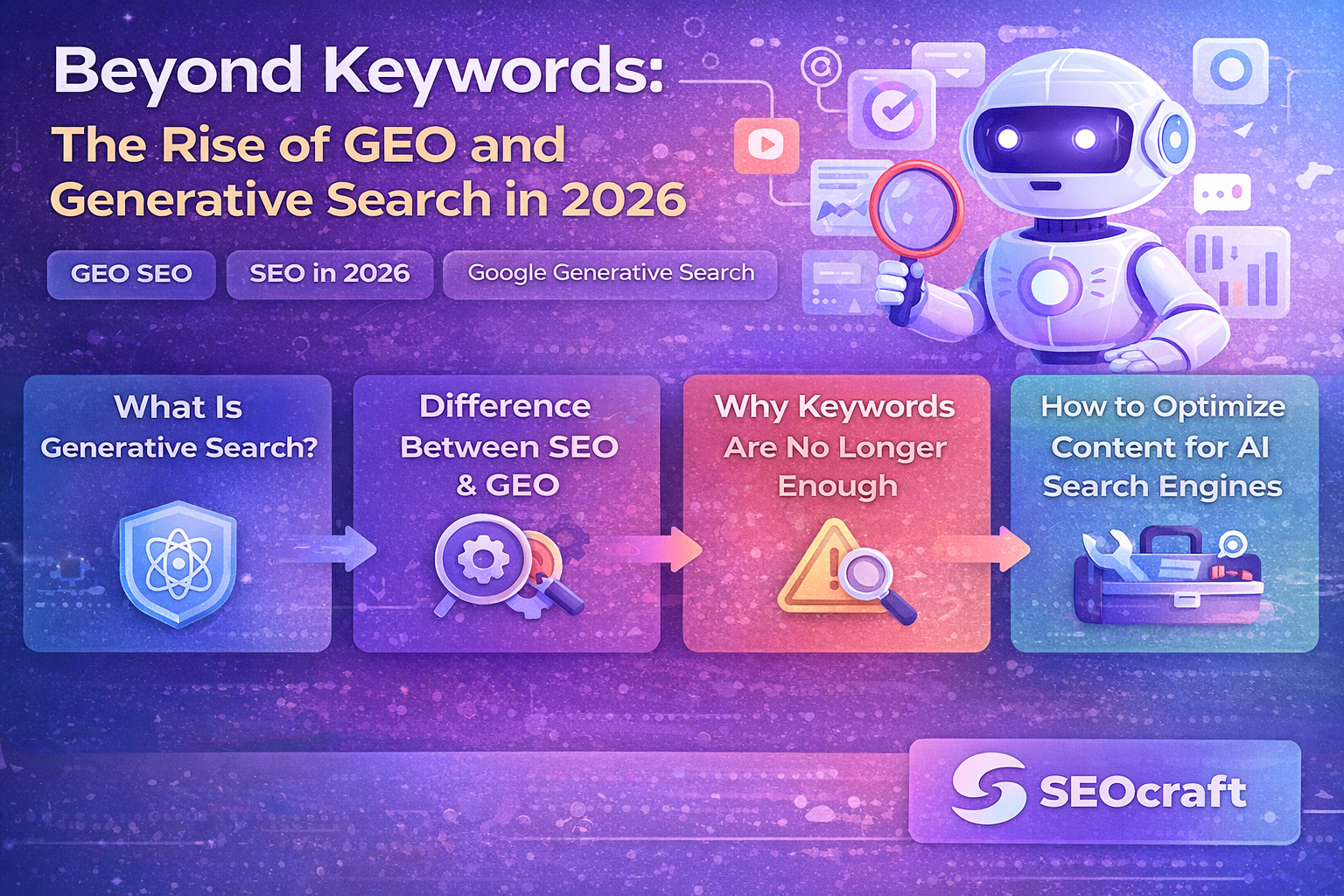
For more than two decades, search engine optimization revolved around one core concept: keywords. If you identified the right keywords, placed them strategically, and built enough backlinks, your content could rank.
But as we move deeper into 2026, this model is no longer sufficient.
Search engines—especially Google—are no longer just indexing pages. They are understanding, summarizing, and generating answers. With the rise of Generative Search Experiences (GSE) and AI-powered results, visibility now depends on more than keyword matching.
This shift has introduced a new optimization layer known as GEO: Generative Engine Optimization.
In this article, we’ll explore:
-
What GEO really means
-
How generative search works in 2026
-
Why keywords alone are losing power
-
How to optimize content for AI-driven search
-
Practical strategies using real SEO tools from SEOcraft
What Is Generative Search?
Generative search is a search experience where the engine doesn’t just show links—it creates answers.
Instead of:
“Here are 10 blue links. Choose one.”
Users now see:
-
AI-generated summaries
-
Direct explanations
-
Actionable steps
-
Source-based recommendations
These answers are created by analyzing multiple trusted sources, extracting meaning, and generating a coherent response.
Key Characteristics of Generative Search
-
Understands context, not just keywords
-
Prioritizes expertise and clarity
-
Pulls information from structured and well-organized content
-
Rewards topical authority, not keyword repetition
This is why GEO matters.
From SEO to GEO: What’s the Difference?
Traditional SEO focuses on:
-
Keyword density
-
Exact-match phrases
-
Backlinks
-
Technical signals
GEO focuses on:
-
Entity understanding
-
Content structure
-
Semantic relationships
-
Answer quality
-
Trust and authority
SEO vs GEO (Quick Comparison)
| Traditional SEO | Generative SEO (GEO) |
|---|---|
| Keyword-based | Meaning-based |
| Page ranking | Answer selection |
| Link-focused | Context-focused |
| Traffic-driven | Visibility-driven |
| Search results | AI-generated summaries |
In 2026, ranking below an AI-generated answer means fewer clicks—even if you're technically “#1”.
Why Keywords Are Losing Their Dominance
Keywords are not dead—but they are no longer the primary signal.
Search engines now ask:
-
Does this content answer the question completely?
-
Is it clear and structured?
-
Can it be trusted?
-
Is it written for humans, not algorithms?
Over-optimized pages filled with keywords but lacking depth are often ignored by generative systems.
That’s why modern content must focus on:
-
User intent
-
Real explanations
-
Clear sections
-
Actionable insights
How Generative Engines Choose Content
Generative systems don’t rank pages the same way traditional search does.
They select sources based on:
-
Topical authority
-
Structured content (headings, lists, schema)
-
Consistency across the site
-
Clear definitions and explanations
-
Trust signals
This is where technical and semantic SEO tools become essential.
The Role of Structured Data in GEO
Structured data helps AI systems understand your content, not just crawl it.
Schema markup allows you to define:
-
What your content is about
-
Who it’s for
-
How it should be interpreted
Using tools like the Schema Markup Generator from SEOcraft makes this process simple and accurate:
https://www.seocraft.io/tools/schema-markup-generator/
By adding structured data, you increase your chances of:
-
Being cited in AI-generated answers
-
Appearing in knowledge panels
-
Becoming a trusted source
Content Structure: The Hidden GEO Signal
Generative engines prefer content that is:
-
Clearly divided into sections
-
Easy to scan
-
Logically organized
Before publishing any article, analyze its structure and clarity.
The SEO Smart Analyzer can help identify weak points in headings, keyword usage, and content flow:
https://www.seocraft.io/tools/seo-smart-analyzer/
Well-structured content is easier for AI to:
-
Extract key ideas
-
Summarize accurately
-
Attribute correctly
Internal Linking in the Age of GEO
Internal links are no longer just for crawling—they help define context.
When you link related tools and resources:
-
You strengthen topical authority
-
You guide AI systems through your content ecosystem
-
You increase trust and consistency
For example:
-
Linking a technical explanation to a Meta Tag Generator
https://www.seocraft.io/tools/meta-tag-generator/ -
Or referencing XML structure using a Sitemap Generator
https://www.seocraft.io/tools/sitemap-xml-generator/
This creates a semantic network, not just isolated pages.
Entity Optimization: The Core of GEO
Entities are people, tools, concepts, brands, and topics.
Instead of repeating “SEO tools”:
-
Explain what SEO tools do
-
Define their purpose
-
Show relationships between tools and outcomes
This helps generative engines recognize you as an authority, not just a keyword match.
Writing for Humans First (Finally)
Ironically, GEO has brought SEO back to its roots: good writing.
High-performing generative content:
-
Sounds natural
-
Explains ideas clearly
-
Avoids robotic phrasing
-
Provides real value
If your content reads like it was written “for Google,” it’s likely ignored by AI summaries.
Practical GEO Optimization Checklist for 2026
Use this checklist before publishing:
-
Clear H1 and logical subheadings
-
Answer-first content structure
-
Natural keyword usage (not forced)
-
Internal links to relevant tools
-
Structured data where applicable
-
Content reviewed with an SEO analyzer
-
Written in a human, authoritative tone
Why SEOcraft Is Built for the GEO Era
SEOcraft isn’t just a collection of tools—it’s a modern optimization platform designed for how search works now.
With tools that help you:
-
Structure content
-
Generate schema
-
Analyze on-page clarity
-
Build technical trust
SEOcraft supports both traditional SEO and Generative Engine Optimization—which is exactly what 2026 demands.
Final Thoughts: Visibility Is the New Ranking
In generative search, success isn’t just about ranking first—it’s about being chosen.
Chosen to:
-
Be cited
-
Be summarized
-
Be trusted
And that only happens when your content goes beyond keywords.
By focusing on structure, clarity, entities, and real value—and using the right tools—you don’t just adapt to the future of search.
You lead it.